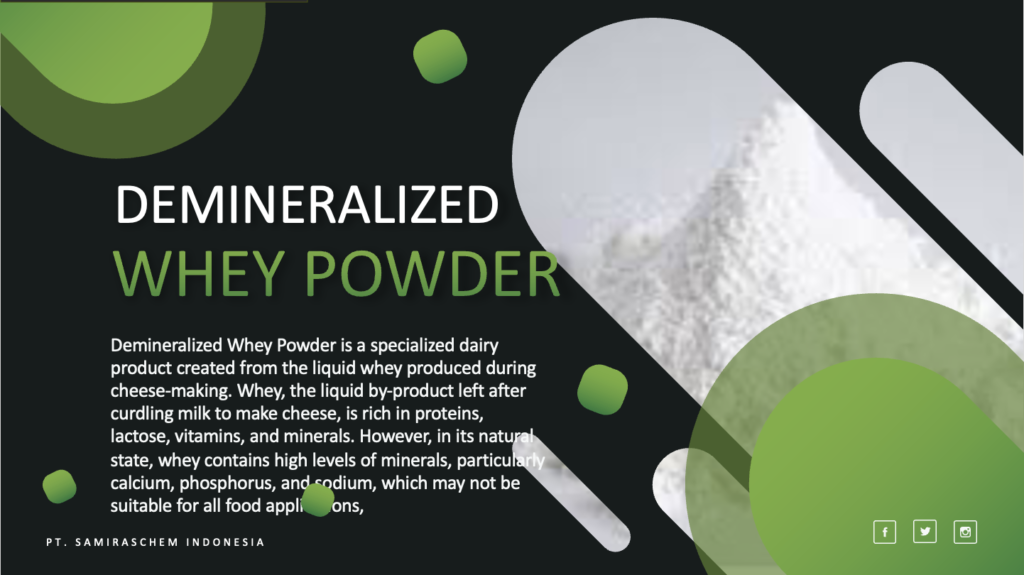
Demineralized Whey Powder
Demineralized Whey Powder is a specialized dairy product created from the liquid whey produced during cheese-making. Whey, the liquid by-product left after curdling milk to make cheese, is rich in proteins, lactose, vitamins, and minerals. However, in its natural state, whey contains high levels of minerals, particularly calcium, phosphorus, and sodium, which may not be suitable for all food applications, especially those requiring lower mineral content, such as infant formula or medical nutrition products.
Introduction to Demineralized Whey Powder
To address this, whey can be “demineralized” through various processes that remove a portion of the minerals, resulting in (DWP). The degree of demineralization can vary depending on the specific requirements, with typical levels being 40%, 70%, 90%, or even higher, depending on how much of the original mineral content has been removed.
Many of the valuable components of whey, such as lactose and proteins, while offering improved versatility due to its reduced mineral content. It is a key ingredient in infant formula, confectionery products, bakery items, and a range of other food products where low mineral content desire.
Production Process of Demineralized Whey Powder
The production of Demineralized Whey Powder involves several stages, from whey extraction to the demineralization process and eventual drying into powder. Each step is crucial for ensuring that the final product retains its beneficial properties while reducing its mineral content to the desired level. Below is an outline of the key steps involved in producing Demineralized Whey Powder:
1. Whey Extraction
is derived from the whey produced during the cheese-making process. After milk is coagulated with the help of enzymes or acids, it separates into solid curds (used to make cheese) and liquid whey. This whey is collected and serves as the raw material for whey powder production.
2. Clarification and Filtration
Once whey is separated, it undergoes clarification and filtration processes to remove residual fats, casein fines (small particles of cheese curd), and other impurities. This step ensures that the whey is clean and ready for further processing. Ultrafiltration (UF) and microfiltration (MF) techniques are often used to purify the whey.
3. Demineralization Process
Demineralization is the key step in producing Demineralized Whey Powder. There are several methods used to remove minerals from whey, including:
-
- Ion Exchange: In this method, whey is passed through ion exchange columns containing resins that selectively bind and remove mineral ions like calcium, phosphorus, and sodium. This technique allows for precise control over the degree of demineralization.
- Electrodialysis: Electrodialysis involves passing the whey through an electrical field, which drives the migration of charged mineral ions across membranes, effectively separating them from the whey. This method is efficient and commonly used for high degrees of demineralization (e.g., 90% or more).
- Nanofiltration: Nanofiltration is a membrane-based separation process that selectively filters out minerals based on molecular size. typically use to achieve moderate demineralization levels (e.g., 40% to 70%).
Depending on the final product specifications, the whey may undergo one or more of these processes to achieve the desired level of demineralization.
4. Concentration
After the demineralization process, the whey concentrate by removing water through evaporation. This step reduces the volume of the whey and increases the concentration of lactose and proteins. Evaporation conduct under reduced pressure to prevent excessive heating, which could damage heat-sensitive components like proteins and vitamins.
5. Spray Drying
The concentrated whey then convert into powder through spray drying, the most common method for drying dairy products. In spray drying, the whey atomize into fine droplets and sprayed into a drying chamber with hot air (around 160°C to 200°C). The moisture evaporates almost instantly, leaving behind dry powder particles. These particles collect and sifted to ensure uniform size and texture before package.
6. Packaging and Storage
Once dried, package in airtight containers or bags to protect it from moisture and environmental contaminants. Proper storage is crucial to maintaining the quality and shelf life of the powder. Demineralized Whey Powder has a shelf life of up to 18-24 months when stored in cool, dry conditions.
Types of Demineralized Whey Powder
The level of varies depending on its intended use. Here are the most common types based on the degree of mineral removal:
1. 40% Demineralized Whey Powder
This type of Demineralized Whey Powder has had 40% of its original mineral content removed. It retains a significant amount of minerals, making it suitable for bakery products, confectionery, and some dairy products where moderate mineral levels are acceptable or even beneficial.
2. 70% Demineralized Whey Powder
With 70% of the minerals removed, this type use in applications where lower mineral content need but where some mineral presence is still desirable, such as in dairy products, processed foods, and certain confectioneries. It offers improved solubility and a more neutral flavor compared to less demineralized variants.
3. 90% Demineralized Whey Powder
90% Demineralized Whey Powder often use in infant formula, medical nutrition, and specialized food products requiring very low mineral content. This type preferre when it’s crucial to limit mineral intake, for example, in infant or clinical nutrition where excess minerals like sodium or phosphorus may pose health risks.
Nutritional Composition
retains much of the nutritional value of regular whey, including high levels of lactose and proteins. However, its mineral content is reduced depending on the degree of demineralization. Below is an overview of the key nutrients in Demineralized Whey Powder:
1. Lactose
Lactose is the primary carbohydrate in Demineralized Whey Powder, typically making up 70% to 80% of the product by weight. Provides sweetness and is easily digestible for most individuals, making Demineralized Whey Powder an ideal ingredient in infant formula and dairy-based foods. Also contributes to the browning of baked goods through the Maillard reaction, enhancing flavor and appearance.
2. Proteins
contains 10% to 14% high-quality proteins, including essential amino acids. Whey proteins such as beta-lactoglobulin, alpha-lactalbumin, and immunoglobulins rapidly absorbe by the body recognizedfor their excellent nutritional value. These proteins support growth and muscle repair, making Demineralized Whey Powder a valuable ingredient in nutritional supplements and infant formula.
3. Reduced Minerals
Depending on the level of demineralization, the mineral content of Demineralized Whey Powder is significantly lower than that of standard whey powder. Key minerals like calcium, phosphorus, sodium, and potassium reduce to varying degrees, making the powder suitable for applications where controll mineral intake is essential, such as in infant nutrition or certain medical diets.
4. Vitamins
retains water-soluble vitamins present in whey, particularly B-vitamins such as riboflavin (vitamin B2) and vitamin B12. These vitamins are essential for energy metabolism, red blood cell production, and overall health.
5. Fat
Demineralized Whey Powder typically contains low levels of fat (around 1% to 2%). Most of the fat remove during the cheese-making process, making this powder a low-fat ingredient suitable for a variety of food applications.
Applications of Demineralized Whey Powder
Due to its reduced mineral content and retained nutritional value, to use in a wide range of food and nutrition applications. Here are some of its key uses:
1. Infant Formula
One of the primary applications of Demineralized Whey Powder is in the production of infant formula. The low mineral content makes it suitable for use in formulas designed for infants, who have specific nutritional needs and should not consume high levels of certain minerals like sodium and phosphorus. Demineralized Whey Powder provides essential lactose and high-quality proteins to support healthy infant growth and development.
2. Medical Nutrition
In clinical nutrition, especially for individuals with conditions that require controlled mineral intake, such as kidney disease or certain metabolic disorders, often use in specialized food products. Its low mineral content helps prevent the overconsumption of electrolytes and other minerals that may be harmful in such populations, while still providing valuable nutrients like lactose and proteins.
3. Confectionery
In the confectionery industry, Demineralized Whey Powder use in products such as caramels, chocolates, and toffees. It adds sweetness and improves texture while contributing to the smooth mouthfeel of these products. Additionally, its reduced mineral content helps prevent unwanted crystallization, which can affect the texture of confectionery products.
4. Bakery Products
a useful ingredient in baked goods like bread, cakes, cookies, and pastries. It provides a source of lactose, which enhances browning during baking, giving products a golden color and rich flavor. The whey proteins also help improve the structure and texture of baked goods, contributing to a softer crumb and extended shelf life.
5. Dairy Products
Demineralized Whey Powder is used in a variety of dairy-based products, including yogurt, ice cream, and cheese spreads. It improves the texture, flavor, and nutritional profile of these products while contributing to the overall quality of the final product.
Advantages
offers numerous advantages, particularly in food applications where controlled mineral content is important:
1. Nutritional Benefits
Despite the reduction in mineral content, Demineralized Whey Powder retains essential proteins, lactose, and vitamins. It provides a valuable source of nutrition in products like infant formula and medical nutrition where maintaining high nutritional value is critical.
2. Versatility
Use in a wide range of applications, from infant formula to confectionery, bakery, and dairy products. Its versatility makes it a staple ingredient in various industries.
3. Neutral Flavor
The reduced mineral content gives Demineralized Whey Powder a more neutral taste compared to regular whey powder. This makes it ideal for products where a delicate flavor desire, such as in infant formula or certain medical foods.
4. Cost-Effective Ingredient
more affordable compared to other dairy ingredients like whey protein isolate or concentrate, making it a cost-effective option for manufacturers while still providing high-quality nutrition.
PT. Samiraschem Indonesia is Reliable Supplier and Distributor Demineralized Whey Powder with High Quality Product and Good Price.
Demineralized Whey Powder is a valuable and versatile dairy ingredient with reduced mineral content, making it ideal for use in infant formula, medical nutrition, confectionery, bakery, and dairy products. Its production involves sophisticated techniques like ion exchange and electrodialysis to carefully remove minerals while retaining essential nutrients like proteins, lactose, and vitamins. With its numerous benefits, including nutritional value, versatility, and cost-effectiveness, Demineralized Whey Powder plays an important role in modern food production.