Methyl Acetate
Methyl Acetate: A Comprehensive Overview
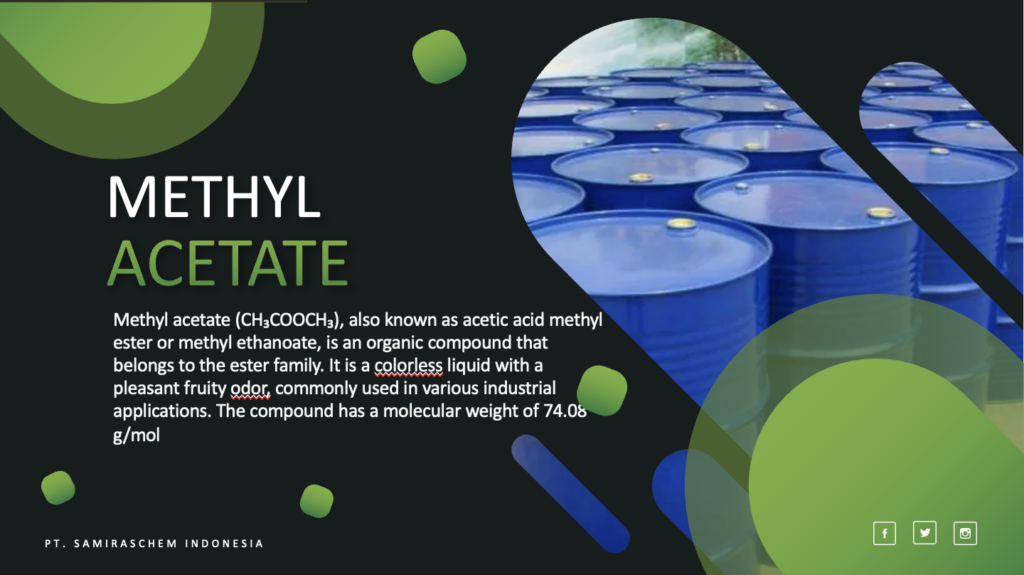
Methyl acetate (CH₃COOCH₃), also known as acetic acid methyl ester or methyl ethanoate, is an organic compound that belongs to the ester family. It is a colorless liquid with a pleasant fruity odor, commonly used in various industrial applications. The compound has a molecular weight of 74.08 g/mol and a chemical structure that includes an ester linkage (-COO-) between a methyl group (-CH₃) and an acetate group (CH₃CO-).
1. Introduction to Methyl Acetate
The ester functional group makes methyl acetate highly reactive in certain chemical processes, allowing it to serve as a solvent, an intermediate in chemical reactions, and a feedstock in the production of other materials. Methyl acetate is also noted for its low toxicity and favorable environmental profile, making it a preferred solvent in industries where eco-friendliness is a priority.
2. Physical and Chemical Properties
exhibits several physical and chemical properties that define its applications and handling requirements:
- Appearance: Clear, colorless liquid
- Odor: Fruity, reminiscent of apples or pears
- Boiling Point: 56.9°C (134.4°F)
- Melting Point: −98°C (−144°F)
- Density: 0.934 g/cm³ at 20°C
- Vapor Pressure: 173 mmHg at 20°C
- Solubility in Water: 25 g/L at 20°C, making it partially miscible
- Flash Point: -10°C (14°F)
- Viscosity: Low viscosity, which contributes to its effectiveness as a solvent
Chemically, is moderately polar due to the presence of the ester group. Its polarity allows it to dissolve both polar and nonpolar substances, which is useful in cleaning and degreasing applications.
Methyl Ethanoate is volatile, evaporating readily at room temperature. Its relatively low boiling point and high vapor pressure mean it is classified as a volatile organic compound (VOC). However, compared to other VOCs, it has a low level of photochemical reactivity, meaning it is less likely to contribute to smog formation when released into the atmosphere.
3. Production of Methyl Acetate
Methyl acetate is typically produced via esterification, a reaction between methanol (CH₃OH) and acetic acid (CH₃COOH), both of which are readily available. This reaction is catalyzed by acids such as sulfuric acid or solid acid resins:
CH3OH+CH3COOH⟷CH3COOCH3+H2O
The reaction is reversible, so the production of methyl acetate requires the removal of water to drive the equilibrium toward the formation of the ester. In an industrial setting, continuous processes are often employed where methanol and acetic acid are reacted in a distillation column, and the resulting methyl acetate is separated from water by azeotropic distillation.
Another method of producing methyl acetate is the carbonylation of methanol, where methanol and carbon monoxide (CO) react in the presence of a catalyst (often a rhodium or iridium complex) to form acetic acid, which then reacts with excess methanol to produce methyl acetate. This method is commonly used in large-scale industrial settings due to its efficiency and yield.
4. Applications of Methyl Acetate
used in a variety of industries due to its versatility as a solvent, reagent, and intermediate. Some of its key applications include:
4.1 Solvent in Coatings and Paints
Methyl acetate’s most common application is as a solvent in coatings, paints, varnishes, and lacquers. Its quick evaporation rate and solvency power allow it to dissolve a wide range of resins and polymers used in the formulation of these products. It contributes to the ease of application and rapid drying of coatings, which is especially important in industries such as automotive refinishing, furniture, and printing.
In this role, methyl acetate often serves as a substitute for more harmful or less environmentally friendly solvents like toluene, xylene, or acetone. Its lower toxicity and favorable environmental properties make it a preferred option in formulations that comply with stringent air quality and worker safety regulations.
4.2 Adhesives and Sealants
also used in the adhesives and sealants industry, where it serves as a solvent for various synthetic polymers, such as polyvinyl acetate (PVA) and acrylics. Its rapid evaporation helps adhesives set quickly, making it ideal for high-speed production lines and in applications where fast drying is necessary.
4.3 Chemical Intermediate
In the chemical industry, is used as an intermediate in the synthesis of other chemicals, particularly in the production of acetic anhydride, a key reagent in the manufacture of cellulose acetate, pharmaceuticals, and other specialty chemicals. The production of acetic anhydride typically involves the reaction of methyl acetate with carbon monoxide in the presence of a catalyst.
4.4 Cleaning and Degreasing
Methyl acetate is used as a cleaning solvent, particularly in the electronics industry, where it helps remove flux residues from circuit boards and other electronic components. Its low viscosity and effective solvency properties make it suitable for degreasing metal parts and surfaces.
4.5 Cosmetics and Personal Care
In the cosmetics and personal care industry, methyl acetate is sometimes used as a solvent in the formulation of nail care products, including nail polishes and removers. Its ability to dissolve both polar and nonpolar substances makes it an effective ingredient in these products.
4.6 Pharmaceutical Industry
Methyl acetate is employed in the pharmaceutical industry for the extraction and purification of active pharmaceutical ingredients (APIs). It is also used as a reaction solvent in the synthesis of various drug molecules due to its favorable chemical properties.
4.7 Flavor and Fragrance Industry
Due to its fruity odor, methyl acetate is occasionally used as a flavoring agent and in fragrances. It is particularly common in formulations that aim to impart fruity or sweet notes, although its use in food and beverages is more limited compared to other esters like ethyl acetate.
5. Environmental Impact and Safety
Methyl acetate is generally considered to be less harmful to human health and the environment compared to other organic solvents. However, it is still classified as a volatile organic compound (VOC), and its emissions can contribute to the formation of ground-level ozone and photochemical smog under certain conditions.
5.1 Toxicity
characterized by relatively low toxicity, particularly when compared to solvents like benzene or methylene chloride. It is considered to be of low acute toxicity when inhaled or ingested, though exposure to high concentrations can cause dizziness, headache, and irritation of the respiratory tract. Prolonged or repeated exposure can lead to more serious health effects, such as central nervous system depression.
In liquid form, methyl acetate can cause irritation to the skin and eyes upon direct contact. Inhalation of vapors at high concentrations in poorly ventilated areas can lead to more severe symptoms, such as nausea, drowsiness, or loss of consciousness. However, typical occupational exposures are unlikely to reach these levels when proper safety measures are followed.
5.2 Environmental Effects
Methyl acetate is biodegradable, and it breaks down relatively quickly in the environment, reducing its potential for long-term ecological harm. In water, it undergoes hydrolysis to form methanol and acetic acid, both of which are readily biodegradable. In the atmosphere, methyl acetate has a short half-life due to its reaction with hydroxyl radicals, leading to its decomposition into carbon dioxide and water.
Despite its favorable environmental profile, methyl acetate can still contribute to air pollution when released in large quantities. Its emissions are regulated under various environmental laws aimed at reducing VOC emissions in industries like coatings, adhesives, and printing.
5.3 Flammability
highly flammable and poses a fire hazard when stored or handled improperly. Its flash point is −10°C (14°F), which means it can ignite at relatively low temperatures. Therefore, it must be stored in appropriate containers and handled in well-ventilated areas away from open flames or sources of ignition.
Firefighting measures for methyl acetate involve the use of dry chemical, foam, or carbon dioxide extinguishers. Water should not be used, as methyl acetate is only partially miscible in water and can float on the surface, spreading the fire.
6. Regulatory Aspects
Methyl acetate is subject to various regulations in different jurisdictions due to its classification as a volatile organic compound (VOC). In the United States, for example, the Environmental Protection Agency (EPA) includes methyl acetate in its list of VOCs that are regulated to reduce air pollution and smog formation. However, because methyl acetate has low photochemical reactivity, it is often treated more leniently than other VOCs in terms of emissions controls.
In Europe, subject to the REACH (Registration, Evaluation, Authorization, and Restriction of Chemicals) regulation, which requires manufacturers and importers to assess and manage the risks associated with the use of chemicals. Methyl acetate has been registered under REACH, and its environmental and health effects are well-documented.
The Occupational Safety and Health Administration (OSHA) in the U.S. has established permissible exposure limits (PELs) for methyl acetate in the workplace, and employers must ensure that workers are not exposed to concentrations above these limits. In addition, the American Conference of Governmental Industrial Hygienists (ACGIH) has set threshold limit values (TLVs) for methyl acetate to protect worker health.
7. Alternatives and Substitutes
While is widely used, there are situations where alternative solvents may be preferred due to specific performance, safety, or regulatory considerations. Common alternatives to methyl acetate include:
- Ethyl Acetate: Similar to methyl acetate in terms of structure and properties, ethyl acetate has a slightly higher boiling point and a stronger odor. It is used in many of the same applications, such as coatings, adhesives, and cleaning.
- Acetone: Acetone is a powerful solvent with excellent solvency for a wide range of organic compounds. However, it is more volatile and flammable than methyl acetate, which may limit its use in certain applications.
- Propylene Glycol Methyl Ether Acetate (PGMEA): This solvent is used in applications requiring a slower evaporation rate than methyl acetate and is often preferred in high-performance coatings and inks.
8. Future Trends and Sustainability
With growing emphasis on sustainability and reducing the environmental impact of industrial processes, there is increasing interest in finding green alternatives to traditional solvents like methyl acetate. One trend is the development of bio-based methyl acetate, produced from renewable feedstocks rather than petrochemicals. Advances in biotechnology and green chemistry are enabling the production of bio-methanol and bio-acetic acid, which can be used to produce bio-based methyl acetate.
In addition, efforts to minimize solvent use and reduce emissions of volatile organic compounds (VOCs) are driving innovation in low-VOC and water-based formulations. While methyl acetate remains a valuable solvent in many industries, its use may decline in favor of more sustainable alternatives that meet the increasing regulatory and environmental demands of the future.
9. PT. Samiraschem Indonesia is Reliable Supplier and Distributor Methyl acetate with High Quality Product and Good Price. We are Serving and Delivered Area such Jakarta Bandung Semarang Jogja Surabaya Medan and Batam
Methyl acetate is a versatile and important chemical with a wide range of applications across various industries. Its physical and chemical properties make it a highly effective solvent, particularly in coatings, adhesives, and cleaning products. Its low toxicity, biodegradability, and relatively low environmental impact contribute to its appeal as a more sustainable alternative to other solvents.
Despite its many advantages, methyl acetate is not without its challenges, particularly in terms of its volatility and flammability. Proper handling, storage, and regulatory compliance are essential to ensure safe and effective use.
As the demand for greener and more sustainable solutions continues to grow, the future of methyl acetate will likely involve further innovations in bio-based production and more environmentally friendly applications. Nonetheless, it will remain an integral component of many industrial processes for the foreseeable future.