Aspartame
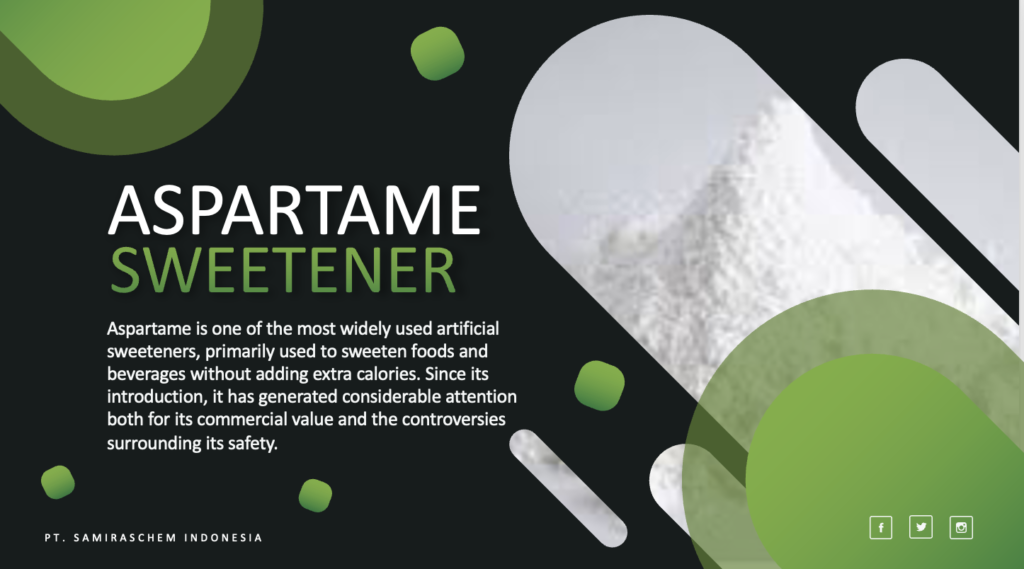
Aspartame is one of the most widely used artificial sweeteners, primarily used to sweeten foods and beverages without adding extra calories. Since its introduction, it has generated considerable attention both for its commercial value and the controversies surrounding its safety. This detailed exploration will cover the chemistry, metabolism, applications, safety profile, regulatory status, and controversies surrounding aspartame, culminating in a thorough understanding of this compound.
1. Introduction to Aspartame
Aspartame (chemical formula: C₁₄H₁₈N₂O₅) is a low-calorie artificial sweetener that is about 200 times sweeter than sucrose (table sugar). It was first synthesized in 1965 by James M. Schlatter, a chemist working for G.D. Searle & Company, while researching treatments for ulcers. Aspartame’s sweetening power lies in its ability to activate the sweet taste receptors on the tongue. Because it is intensely sweet, only small amounts are required to sweeten foods and drinks, making it a popular choice for diet and sugar-free products.
Structurally, is a dipeptide composed of two amino acids: aspartic acid and phenylalanine. It also contains a methyl ester group. Upon digestion, aspartame breaks down into these components, which are absorbed and metabolized by the body.
2. Aspartame’s Chemical Properties
- Molecular formula: C₁₄H₁₈N₂O₅
- Molar mass: 294.31 g/mol
- Appearance: White, odorless, crystalline powder
- Melting point: Approximately 246-247 °C (475 °F)
- Solubility: Moderately soluble in water, insoluble in fat and alcohol
- Sweetness intensity: Around 200 times sweeter than sucrose
chemical structure allows it to deliver high sweetness with minimal amounts required, thus contributing little to the calorie content of foods and beverages. However, aspartame is unstable at high temperatures, which limits its use in baked or heat-processed foods. In such cases, other artificial sweeteners are typically used.
3. Metabolism of Aspartame
Once consumed, aspartame is rapidly metabolized in the gastrointestinal tract into its three constituent components:
- Aspartic acid
- Phenylalanine
- Methanol
Aspartic Acid: Aspartic acid is a naturally occurring amino acid and is found in many protein-containing foods. It serves as a neurotransmitter and is involved in the synthesis of other amino acids. In the amounts derived from aspartame consumption, aspartic acid is considered safe for most individuals.
Phenylalanine: Phenylalanine is an essential amino acid that is required for the production of neurotransmitters like dopamine and norepinephrine. However, individuals with phenylketonuria (PKU), a rare genetic disorder, cannot metabolize phenylalanine efficiently. This leads to a buildup of the amino acid, which can cause brain damage and cognitive disabilities if not controlled. For this reason, products containing aspartame must be labeled with a warning for those with PKU.
Methanol: Methanol is a type of alcohol that is toxic in high amounts. However, the amount of methanol produced from the breakdown is small and is comparable to the methanol content found in natural foods like fruits and vegetables. The body can safely metabolize these small amounts of methanol into formaldehyde and then into formic acid, which is excreted through urine.
4. Uses of Aspartame
Aspartame is used in a wide variety of foods and beverages due to its sweetness and low-calorie content. It is particularly popular in products marketed toward individuals seeking to reduce sugar intake or calorie consumption. Some common uses of aspartame include:
- Soft drinks and diet sodas: is commonly used in sugar-free and diet sodas. Brands like Diet Coke and Diet Pepsi often use aspartame as a sweetener to reduce the calorie content without compromising sweetness.
- Chewing gum: Many sugar-free chewing gums contain aspartame for its long-lasting sweetness.
- Desserts and dairy products: can be found in sugar-free or reduced-calorie versions of ice creams, yogurts, puddings, and gelatins.
- Sugar substitutes: is available as a table-top sweetener under various brand names, including Equal and NutraSweet, which can be used to sweeten coffee, tea, or other beverages.
- Pharmaceuticals: Aspartame is often used in chewable vitamins, sugar-free syrups, and other medications where sweetness is needed.
Aspartame is approved for use in over 100 countries, including the United States, European Union, Canada, Australia, and Japan.
5. Safety and Regulatory Approval
Aspartame has been extensively studied for its safety since it was first introduced, and it has been subject to rigorous review by multiple health agencies around the world. The U.S. Food and Drug Administration (FDA) approved aspartame for use in dry foods in 1981, and in carbonated beverages in 1983. Other regulatory agencies, including the European Food Safety Authority (EFSA), the Joint FAO/WHO Expert Committee on Food Additives (JECFA), and Health Canada, have also deemed aspartame safe for consumption within established daily intake limits.
Acceptable Daily Intake (ADI): The ADI for aspartame is set at 40 mg/kg of body weight by the EFSA and JECFA, and 50 mg/kg of body weight by the FDA. For example, a 70 kg (154 lb) adult would need to consume about 20 cans of diet soda per day to reach the FDA’s ADI limit, a quantity far exceeding typical consumption patterns.
Studies and Findings: Thousands of studies have been conducted to assess the safety of aspartame, including long-term studies involving humans and animals. Some key findings include:
- No evidence of carcinogenicity: Numerous studies have investigated whether aspartame causes cancer. The National Cancer Institute (NCI) and other scientific reviews have concluded that there is no link between aspartame consumption and cancer risk.
- No effect on neurological health: Some concerns have been raised about aspartame’s potential effects on brain function, particularly in relation to headaches, seizures, and other neurological symptoms. However, clinical trials and reviews have found no consistent evidence of these effects in the general population.
- Safe for diabetics: Aspartame does not raise blood glucose levels, making it a suitable sweetener for people with diabetes who need to control their sugar intake.
6. Controversies Surrounding Aspartame
Despite extensive evidence supporting aspartame’s safety, it has remained the subject of controversy for decades. Much of the concern stems from anecdotal reports, misinterpretation of scientific data, and the spread of misinformation.
6.1. Health Concerns
Several health concerns have been raised by aspartame critics, ranging from cancer to neurological effects and metabolic issues. However, many of these claims have been debunked or lack sufficient scientific evidence.
- Cancer: The idea that aspartame might cause cancer arose from early animal studies that reported an increased incidence of tumors. However, subsequent research, including large-scale human studies, has failed to find any consistent association between aspartame consumption and cancer.
- Neurological Effects: Some individuals have reported headaches, dizziness, and seizures after consuming aspartame. However, controlled studies have found no consistent evidence to support the idea that aspartame triggers these symptoms in most people. The majority of the studies concluded that reported symptoms might be due to a placebo effect or other factors unrelated to aspartame.
- Phenylketonuria (PKU): As previously mentioned, individuals with PKU must avoid aspartame due to their inability to metabolize phenylalanine. This is the only well-established health risk associated with aspartame, and it is mitigated by mandatory labeling of products containing aspartame.
- Methanol Toxicity: Some critics of aspartame point out that it breaks down into methanol, which is toxic in high amounts. However, aspartame produces only small amounts of methanol, much less than that found in natural foods like fruit juice. The body metabolizes this methanol without harm.
6.2. Internet Misinformation and Public Perception
has become the subject of numerous internet rumors and conspiracy theories, claiming that it causes a wide range of health problems. Some of these claims cite studies that have been refuted or misinterpreted, while others are based on anecdotal evidence without scientific backing.
One of the most persistent myths is that aspartame was originally developed as a biological weapon or that it was rushed through the approval process despite evidence of harm. These claims are not supported by any credible scientific or historical evidence, yet they continue to circulate widely, fueled by social media and alternative health websites.
6.3. Studies with Conflicting Results
While the majority of research supports the safety of aspartame, a few studies have suggested possible adverse effects, particularly in animal models. For example, the Ramazzini Institute in Italy published studies in 2006 and 2007 suggesting a link between aspartame and cancer in rats. However, these studies were criticized by regulatory bodies, including the EFSA and FDA, for methodological flaws and the inability to replicate findings in humans. As a result, the consensus remains that aspartame is safe when consumed within established limits.
7. Regulatory Reviews and Reassessments
Given the ongoing public debate about aspartame, regulatory agencies have periodically reviewed its safety based on the latest scientific evidence.
- FDA Review (1980s): After the initial approval of aspartame, the FDA conducted a thorough review of the safety data, including studies on metabolism, potential toxicity, and carcinogenicity. The FDA affirmed its conclusion that aspartame is safe for human consumption.
- EFSA Reassessment (2013): In 2013, the EFSA conducted a comprehensive risk assessment of aspartame, reviewing over 600 studies. The EFSA concluded that aspartame does not pose a safety concern for the general population.
- WHO Reassessments (2023): In July 2023, the World Health Organization (WHO) and the International Agency for Research on Cancer (IARC) released a report classifying aspartame as “possibly carcinogenic to humans” (Group 2B). This classification was based on limited evidence from human studies and animal experiments. However, the WHO and other health organizations continue to recommend that aspartame is safe for consumption at levels below the established ADI, and there is no need for individuals to stop using products containing aspartame.
8. PT. Samiraschem Indonesia is Reliable Supplier and Distributor Aspartame with High Quality Product and Good Price.
Aspartame is one of the most studied food additives in history, with a large body of evidence supporting its safety for human consumption. It provides a useful tool for reducing sugar and calorie intake, particularly for individuals with diabetes or those seeking to lose weight. Despite decades of controversy, the scientific consensus remains that aspartame is safe when consumed within established daily intake limits.
While some individuals may experience sensitivity to aspartame or prefer to avoid artificial sweeteners altogether, for the vast majority of consumers, aspartame presents no significant health risk. Regulatory bodies around the world continue to monitor new research on aspartame to ensure its continued safety, and periodic reassessments help maintain public trust in its use.